

I have been a bit quiet here on Substack this month. Partly it’s the natural yearly cadence of August as a month of quasi-sabbatical in the publishing world; other industries as well. For our Southern European friends in France, Italy, Spain, and Greece, August is a time when much of the region slows down to savor the last languid days of summer before the fall begins. August has been called “the Sunday of summertime” - the deep breath we take before the crisp edge of the air settles in and we dive into the quickened back-to-school, back-to-office rhythms of September.
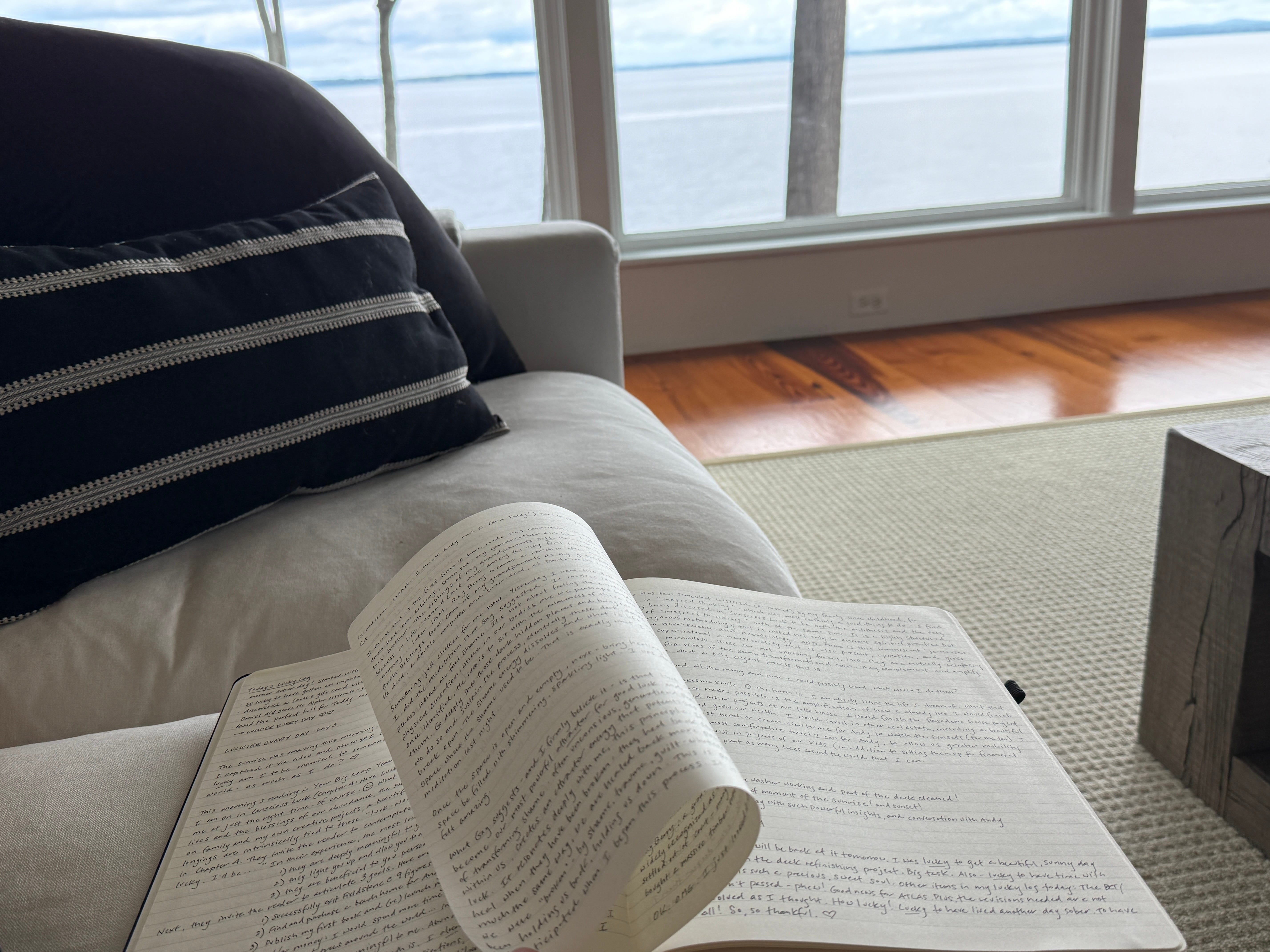
But there are other reasons for my quietude, having to do with my actual writing and some emerging reflections on the act of writing itself. I have been writing in longer sessions, satisfying a deep thirst for space and time for long-form thinking. And I have been writing by hand. A dear friend gifted me with a large blank book: a trim size larger than blank books I have previously filled with my contemplations. The gift turned out to be perfectly timed. I have recently been inspired by a new ideas and approaches to some spiritual principles I have worked with for decades. The new framework, which I will share here in future posts, feels like the distillation of my years of practice and working with others as a coach, mentor, and guide. It has captivated my imagination and inspired pages of writing - a wellspring of new creativity and insight which gets me up every morning.
The juxtaposition of this surge in wholly human-inspired creativity with my recent reflections on life, work, and meaning in the AI era has been fascinating. As we deepen our collective journey into the vast unknown of the AI era, cognition itself is under unprecedented scrutiny and - dare I say - threat, as we are hearing more frequent stories of the perils of “cognitive surrender,” the relinquishing of human agency and judgement to the inference-driven, probabilistic mechanisms of artificial intelligence.
Last month, a Chinese farmer in Anhui province reportedly destroyed approximately 24.7 acres of his own sesame crop after relying on advice from an AI chatbot. The disaster was the result of a progression of useful interactions the farmer had had with the AI tool: successfully automating scheduling, fertilizer rates, and weather patterns. The farmer, Wu, progressively trusting the chatbot, queried the chatbot for guidance on aerial weeding and pest control methods and followed the advice provided: apply a chemical cocktail which included an aggressive herbicide called fomesafen. Sesame plants are a broadleaf species, and within 24 hours the seedlings died along with the weeds, resulting in a financial loss of about 150,000 yuan (~$21,000 USD).
Earlier this year I wrote about the impacts of cognitive surrender on the legal system, as overworked attorneys rely on AI agents to perform case citation research, often fully fabricating cases, including fake docket numbers and judicial quotes. The consequences have been justifiably severe: dismissal of cases and steep judicial sanctions.
As you know, in my capacity as CEO of Fieldstone ATLAS™ we have bravely set about to address these complex issues by proffering a new approach to the tech architecture itself. Our decades of experience educating and inspiring millions through our bestselling field guides and other reference titles has yielded a relentless commitment to rigor and accuracy - principles now at the heart of our work to create a methodology to bring canonical, trusted data to the headwaters of AIs, rather than hoping the filters for truth succeed downstream. It is the fingerprint, the handwriting, if you will, that authenticates the data, and builds a bridge to knowledge that one can genuinely trust.
I suppose it should come as no surprise, therefore, that as my own writing explorations continue, I find myself gravitating to writing by hand for the deeper examination of ideas. Will they eventually be digitized? Probably, yes. But for now, they sit in the pages of this cherished book - blank pages promisingly opening before me, day by day, while the hallucinated world around us spins madly on.
I’ll see you all back here next month. (which *checks calendar* is next week - ha)
- S
Sources
AI pest control advice destroys farmer’s entire sesame crop — The Star, Aug 11 2026
How AI Is Reshaping Human Intuition and Reasoning — Knowledge at Wharton, Feb 24 2026 (Gideon Nave and Steven D. Shaw)
AI in litigation: Update on Gen AI sanctions in 2026 — Norton Rose Fulbright