

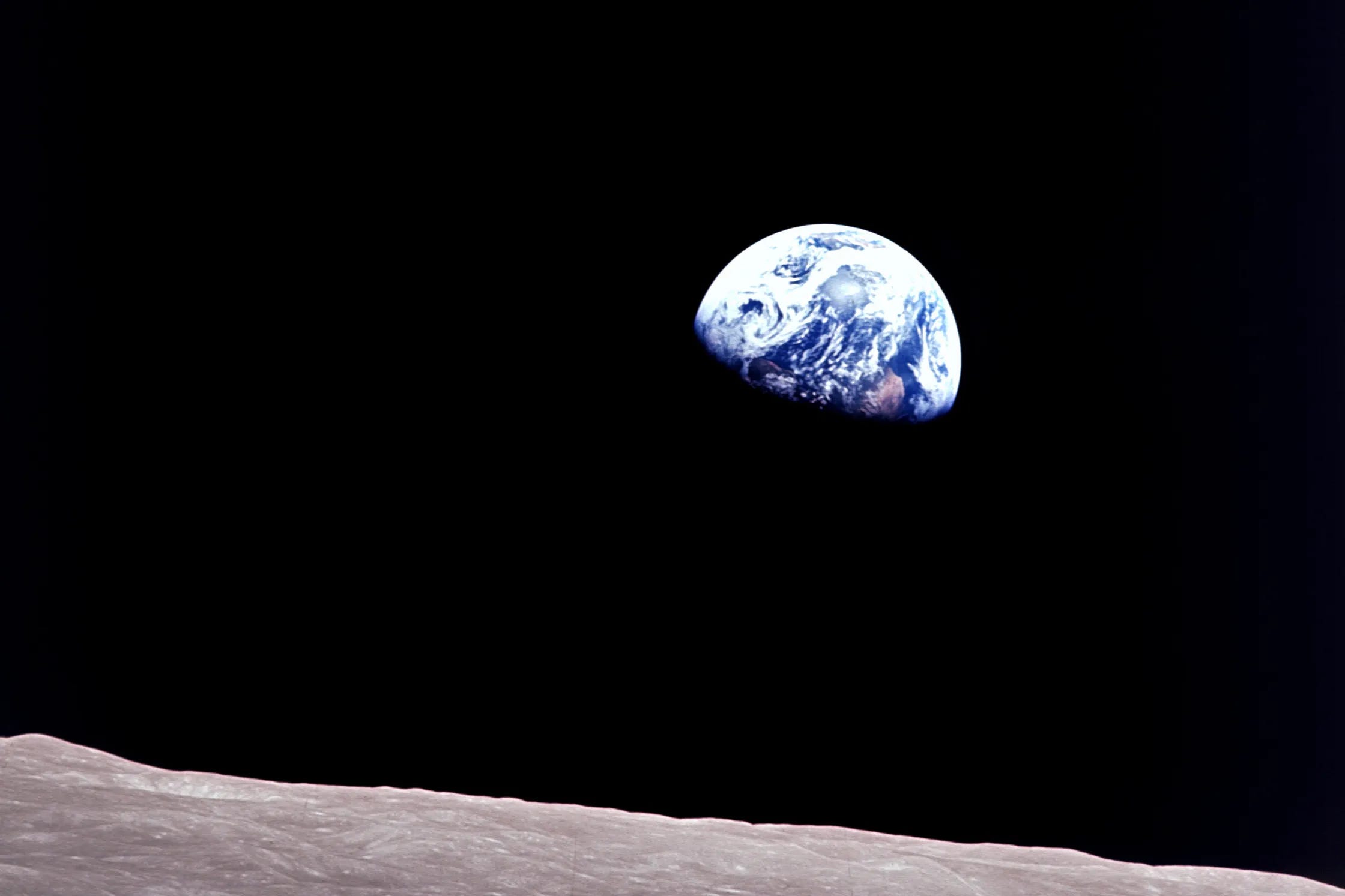
On Christmas Eve 1968, Bill Anders was faced with a choice.
His life in that moment was a series of highly regimented, intensely structured and scheduled activities in a plan that needed to be executed to the exact letter, minute by minute. Gazing out the window, he saw something that took his breath away. It was a sight no human being had ever seen before.
“Oh my God, look at that picture over there,” he said to his colleague Frank Borman. “Hey, don’t take that,” Borman joked. “It’s not scheduled.”
But Anders, rookie astronaut and lunar photographer on the Apollo 8 mission, insisted, asking his colleague James Lovell for color film. “Earthrise,” as it was later called, became the most influential environmental photograph of all time, and one of the most famous photographic images in history.
Had Anders adhered strictly to the plan, we may not have Earthrise, nor the global shift in consciousness and public policy that resulted. To see our delicate planet, a blue-green orb set against the vastness of space, in this entirely new way, was catalytic. Earthrise was the inspiration for the modern environmental movement and the first Earth Day on April 22, 1970. Later that year, the 91st Congress nearly unanimously passed the Clean Air Act, the Senate voting 73-0 and the House of Representatives 375-1. Just weeks earlier, on December 2, 1970, the Environmental Protection Agency (EPA) was established.
The plan and schedule for the Apollo 8 mission had been meticulously designed by scientists and technicians whose chief goal was to keep three men alive in space. Every minute was calibrated to that objective. But the moment that ultimately defined the mission, and the very notion of space exploration as a whole, was entirely unplanned, in which a human being, inspired by what he saw, departed from the script. That one choice, made spontaneously in an instant, changed the course of history.
Half a century later, history is cycling again. Humanity’s progression through the AI revolution is now in full swing, with adoption and usage exploding at unprecedented rates. In November 2022, OpenAI released ChatGPT as a test, inviting users to help them improve it. Within 5 days there were 1 million users. In less than two months there were 100 million users, becoming the fastest consumer app adoption ever recorded. In 2022, roughly 1 in 10 workers used some form of generative AI in their work. By 2025 that number had grown 4-5x: 78% of organizations, 43% of knowledge workers, and roughly half of all Americans are now using AI. No other technology has moved this fast at this scale.
At its core, AI is an automation technology. Every transformative technological revolution in human history has automated something that used to be done by hand. The Industrial Revolution automated physical labor. The Digital Revolution automated the processing of information and data.
Unlike previous revolutions, however, AI automates cognition itself: analysis, pattern recognition, prioritizing, decision-making, drafting, planning. Complex tasks once considered the unique provenance of the human mind are being executed with increasing efficiency and skill in the virtual hands of our new machine thought partners. Our to-do lists and transactional activities have become delegable, often completed with greater precision, which suggests - jobs and income notwithstanding - the potential for an explosion in human discretionary time in the near future.
Which brings us back to Earthrise and questions implicit in Anders’ photograph: How will we use our time? Freed from a hyper-scheduled agenda, will we look out the window and allow ourselves to be spontaneously moved by what we see? Freed from the to-do lists of our daily lives, what will we focus on instead? The optimists’ answer, offered by technology advocates, is that we will finally be freed for higher-order thinking, creativity, and human connection. More Earthrise moments, in other words. More time to look out the window.
But it also assumes we have trained ourselves to truly see, and to derive meaning from what we see. It also assumes that we haven’t automated or “optimized” our lives to such a degree that that becomes the sole measure of their value.
Anders saw something no human had seen before: the earth from a vantage point outside its orbit. His decision to deviate from Apollo 8’s tightly managed schedule to capture a photo changed history and shaped the way we think about our home planet. It was a definitively human moment, a human decision, made possible through human judgement.
The AI era forces us to consider what aspects of our lives, if any, we will automate. But the deeper question is whether we are preserving the conditions for our own interruptibility. Spontaneity, curiosity, inspiration, moments of transcendence can’t be predicted any more than they can be inferred through scraping the internet. These are the moments that define who we are as a species.
Like Prometheus stealing fire from the gods, we have captured a world-changing power. With it comes world-bearing responsibility. Commoditized cognition comes at a price. At the dawn of this new era, we are already aware of many compelling ways in which this spark is a net gain, broadening the horizons of our capacity to understand the world and universe in which we live. May we continue to stay curious and to deepen our understanding of the fire in our hands. Eyes wide open.
- S
Sources
🌏💙